In this conversation, Sinem Günel from Write • Build • Scale shares the lessons behind creating something genuinely valuable - from earning attention and building trust to understanding what readers actually want from a paid publication.
If you’re building from zero, trying to grow without losing yourself in the numbers, or wondering what separates a publication people simply follow from one they’re willing to invest in, this conversation is worth your time.
Watch the full interview above, then keep reading for the biggest lessons and takeaways I’m applying to my own journey here on Substack.
There are some conversations where you know, even while you’re having them, that you are going to come back to them again and again... this was one of those conversations for me.
I have been looking forward to sitting down with Sinem Günel since I first discovered her on YouTube while trying to make sense of this whole new Substack world I had decided to throw myself into. If you have ever typed some version of “How on earth does Substack work?” into YouTube, there is a very good chance you have found Sinem too.
Alongside Jari Roomer and Philip Hofmacher, she has built Write • Build • Scale into an extraordinary publication and business, with tens of thousands of subscribers and thousands of paid members, so there was obviously plenty I wanted to ask her about growth, paid subscriptions and what it actually takes to become a Substack Bestseller.
But, as often happens with the best conversations, what I took away from it was much bigger than the question I went in wanting answered.
Because we did talk about becoming a bestseller, but we also talked about building the foundations, confidence, consistency, experimentation, visibility and what it really means to create something that offers enough value that people want to pay for.

Starting from zero doesn’t mean starting with nothing…
One of the first things Sinem said was that although Write • Build • Scale has only been on Substack for around two years, she has been writing online since 2018, which is such an important distinction when we look at somebody else’s success and wonder why ours isn’t happening at the same speed.
Sinem didn’t arrive here without experience. She had spent years writing on Medium, experimenting, sharing what she was learning, turning workshops into articles, writing about books she had read and paying attention to what people responded to.
It immediately made me think about the whole premise of Starting From Zero, because the more I build this publication in public, the more I realize that starting from zero is rarely about having nothing.
It’s the opportunity to build something worth growing from all your previous knowledge, wisdom and experience.
I intentionally didn’t import an email list and I wanted to experience what it was really like to build a publication here from a completely blank canvas - because if I was ever going to teach or advise other women on doing this, I wanted to understand what it felt like to actually do it myself by living it out loud.
But I didn’t arrive with zero experience. I brought nearly twenty years of building businesses with me. I brought everything I had learned in media and marketing, publishing magazines, building communities, creating brands, getting things wrong, getting other things right and starting over more times than I probably care to count.
And I think that distinction is particularly important for women at this stage of life. You might be starting a new publication, business, career or chapter and technically the numbers beside your name might say zero on creation, that’s only your starting point for what you’re building at this moment in time.
That feels very different from starting again empty-handed.

Twenty people are still twenty people
Sinem then told a story that I loved because it reminded me how quickly our expectations become distorted online. When she first started writing on Medium, an article receiving twenty views blew her mind.
Twenty people had read something she had written and if somebody left a comment, that mattered. Then, when she received her first payment from her writing, which she remembers being somewhere around seven dollars, she went and told her mum because she couldn’t quite believe she had created something on the internet and somebody had paid her for it.
There was something wonderfully grounding about hearing that from somebody who now has the numbers she has.
When did five hundred people choosing to subscribe to something we created become merely a stepping stone to a thousand, rather than something worth stopping for a moment to appreciate? I am asking myself these questions too.
I recently passed 900 free subscribers on Starting From Zero and, as I write this, that number is already moving quickly, built almost entirely through showing up consistently on Notes, having conversations and allowing people to get to know me before I started heading into their inboxes.
I don’t take that lightly.
Those aren’t 900 numbers on a dashboard to me. They are 900 people who saw something I wrote, felt enough of a connection to want to hear more and invited me into their space.
When you think about it like that, it feels different.
And that led us into one of the most valuable things Sinem said during the entire conversation: Attention has to be earned.

We aren’t entitled to somebody else’s attention
This one landed - big time.
Because I think there is a subtle trap we can fall into when we create something, particularly when we have worked incredibly hard on it. We spend three hours writing an article, another hour editing it, find the perfect image, agonize over the headline, press publish and then somewhere in the back of our minds there is an expectation that people should read it because “look how much work I put into this.”
But the person on the other side of the screen doesn’t know how long it took - she has a life - children, work, dinner to make, messages she hasn’t replied to, twenty other newsletters sitting in her inbox and approximately a million other things competing for her attention.
Our effort does not automatically create an obligation for others to stop what they are doing and to read what we made.
Sinem described this as a kind of entitlement creators can develop without realizing it. We can create something phenomenal, but that still doesn’t mean attention is guaranteed, because the amount of work we put into something and the attention it receives are not directly correlated.
I actually find that incredibly freeing because instead of sitting there thinking, Why isn’t anybody reading my work?, we can ask a much more useful question:
What would make this worth somebody’s attention?
Much more useful and impactful - making it unmistakably something the right person wants to stop and spend time with. That is also a very different way to think about visibility.

I don’t want to feed another content machine
This part of our conversation also helped me articulate something I have been feeling since I arrived on Substack.
Have spent enough years around social media to know what it feels like to feed the machine - you create something, post it, watch what happens for a few hours and then tomorrow you need something else because yesterday’s work has already disappeared beneath everything that came after it.
One of the things I have loved so much about Substack is that it doesn’t feel like that to me because I am still receiving engagement on things I wrote when I first arrived here. An old Note can suddenly be re-stacked. Someone can discover an article weeks or months later and leave a comment that brings it back to life.
Sinem compared that behaviour more closely to YouTube, where a video can suddenly start gaining traction months after it was originally uploaded. She talked about thinking of your Substack as a library, rather than simply focusing on what is appearing in the feed today.
I love that way of thinking about it because I don’t want to spend this next chapter of my life creating disposable content.
I would like somebody to arrive at Starting From Zero six months from now, wander around, read something I wrote months earlier, watch one of these conversations, follow a link into another idea and feel as though she has discovered somewhere worth staying for a while.
That is very different from chasing today’s likes and quick wins.

So what does becoming a bestseller actually mean?
This was the question I really wanted to ask Sinem because right now, there is a lot of conversation on Substack about becoming a bestseller, and understandably so.
We see that little orange badge and think, I want one of those.
But I wanted to know what sits underneath it. What actually makes a publication something people want to pay for?
Sinem’s answer reframed the whole thing for me.
The bestseller badge matters because it is a trust signal. It tells us that at least 100 people have trusted the creator enough to pay for what they are creating, and Sinem made the point that whether somebody pays you one dollar, ten dollars or a hundred dollars, the fundamental shift is the same: you have moved from somebody enjoying your free work to somebody deciding that what you offer has enough value for them to exchange money for it.
That is significant.
Write • Build • Scale talks about the badge in a similar way in their own guide to becoming a bestseller, not as the final destination but as evidence that you have created something people genuinely value. (writebuildscale.substack.com)
And I think that is a far more interesting thing to aim for than a badge.
Trust.
Because you can’t fake that.

Nobody needs another newsletter
Then Sinem said something that I think every person thinking about turning on paid subscriptions needs to hear:
Nobody wants to pay for another newsletter.
I laughed because, of course, she’s right.
Who amongst us is sitting there thinking, Do you know what my life really needs? More email.
We are drowning in it.
What people are prepared to pay for is access to something they believe will make a meaningful difference.
If you share knowledge, Sinem’s advice was to become incredibly clear about who is on the other side of the screen, what she is trying to achieve, what problem she is trying to solve and what you could create that genuinely helps her move forward.
And that could look completely different from one publication to another.
It might be an exceptional paid essay.
It could be a workshop, template, resource library, community, conversation, guide or something we haven’t even thought of yet.
The format is not the point.
The usefulness is.
That immediately made me think about how I am approaching paid membership here, because I don’t want to turn on paid and simply say, Great, now you get more Sarah in your inbox.
That doesn’t feel like enough.
I want to ask what would make somebody who chooses an annual subscription feel genuinely delighted that she did.
What can I create that saves her time, gives her confidence, helps her build something better or allows her to benefit from the things I have spent years learning?
Suddenly the question is no longer:
What should I put behind the paywall?
It becomes:
What would make this worth paying for?
That is the question I want to keep asking.

Maybe we need to stop looking for the perfect Substack formula
I also loved Sinem’s honesty about the questions we all seem to ask when we arrive here….
When should I turn on paid?
How often should I publish?
What time should I post?
How many Notes should I write?
Should I publish one free article and one paid article every week?
We want somebody to give us the answer because a formula makes us feel safe or confirms that we’re doing the right thing.
But Sinem made the point that whenever somebody gives you an absolute answer to a strategic question like that, you should probably be a little cautious, because the answer depends on you.
What are you building? Who is it for? How much time do you have?
What is your ultimate goal? What can you realistically sustain?
That really validated the way I have chosen to build Starting From Zero and the reason I haven’t rushed this process - because I didn’t know the answers.
I didn’t want to arrive here, immediately start sending emails and assume I knew what people wanted from me before I had actually spent any time with them.
Instead, I focused on Notes.
I listened.
I interacted.
I watched who was being drawn into the conversation.
I asked questions.
I allowed people to get to know how I think and write before I started asking for anything in return.
Could I have moved faster? Absolutely!
But I am trying to build something I still want to be nurturing years from now, and I would rather build that intentionally than race towards somebody else’s definition of growth.

Consistency without reflection can keep you stuck
This might have been the lesson I needed most.
We hear constantly that consistency is the answer - just keep showing up writing, publishing, keeping going. And yes, consistency matters enormously.
I know that firsthand because showing up on Notes every day has completely changed my whole experience here. But, Sinem talked candidly about spending almost two years consistently publishing long-form work without the feedback loops that could have helped her progress more quickly.
Eventually, she asked a different question.
What are the people getting better results actually doing differently?
And then she became slightly obsessed with finding out. She printed successful articles using the copier at her internship, took a yellow highlighter to them and studied how they were constructed. She looked at introductions, hooks and structure and started analysing why certain pieces travelled further than others.
They call this “modelling excellence.”
I absolutely love that. There is a big difference between copying somebody and studying what excellence looks like. We do it everywhere else":
Writers read great writers.
Musicians study great musicians.
Designers notice beautiful design.
Entrepreneurs study successful businesses.
Why would we decide that when we arrive on Substack we suddenly have to invent everything from scratch?
We can look at what works, understand why it works and then comes the important part: We make it our own in our own unique way

90% proven and 10% you is enough to begin
At the very end of our conversation, I asked Sinem for one thing somebody could implement today. Her answer was so good that I think I am going to borrow it as a principle for my own work.
Find the proven pattern.
Study what somebody you admire is doing well.
Then ask yourself:
What would I change?
What doesn’t quite feel like me?
What am I curious enough to experiment with?
Sinem suggested thinking about creating something where perhaps 90% is based on a pattern you have reason to believe works, while the remaining 10% becomes your experiment.
Maybe it works brilliantly, or, maybe it falls completely flat - the key is to experiment. Either way, you have learned something and you anything at any point. Until, eventually, all of those tiny experiments start becoming your unique way of doing things.
I find that so much more appealing than the pressure to constantly be groundbreaking. Originality isn’t always about inventing something nobody has ever seen before - it's more about taking what we have learned, filtering it through our own experience, taste, personality and perspective and allowing it to become recognizably ours.

Visibility is Currency
There was another moment in our conversation where I shared something I had read recently that stopped me in my tracks when I read it - visibility is currency.
This really resonated because I have been in business for almost twenty years and I know I have something to say.
I have knowledge and wisdom that I know can help other women.
I have experience,
I have built things.
I have made mistakes.
But if I am completely truthful, there have also been plenty of times when I have hidden. I have been the woman happily creating the magazine behind the scenes but not necessarily stepping forward and saying, Hi, I’m Sarah. I created this.
It has often felt easier to build the thing than to stand beside it and SHOW UP - maybe some of you know exactly what I mean when I say this as I’m sure that I’m not alone.
Particularly as experienced women, we can have an extraordinary amount to contribute while simultaneously feeling uncomfortable drawing attention to ourselves - but this was also a great reminder that visibility does not have to mean performance.
It doesn’t have to mean shouting. It doesn’t have to mean turning ourselves into influencers or becoming somebody we aren’t.
If we genuinely believe our work could help somebody, perhaps making sure she can find it is simply part of the work.
There is a difference between saying “look at me” and saying “I made something that might help you.”
That is the kind of visibility I can get behind.

So, would I still want the bestseller badge?
Absolutely.
I’m not going to pretend otherwise. I will be thrilled when Starting From Zero earns that little orange badge. But after this conversation, I think I understand what I actually want it to represent.
I don’t want 100 people to pay simply because I ran the cleverest promotion.
I want them to stay, feel glad they joined for them to open something I’ve created and think, that was so helpful and exactly what I need.
I want this publication to become a place where women find ideas, conversations, resources, friendships and encouragement for whatever they are building next.
The goal isn’t simply to grow. The goal is to create something worth growing.
A bestseller badge won’t magically create trust if there isn’t substance underneath it. The aim here is to build the substance, nurture trust and create something that offers value.

12 Things I’m Taking Away From My Conversation With Sinem
If you are starting your own Substack - whether you have zero subscribers, 100 or 10,000 - these are the things I would write down somewhere and come back to:
Starting from zero does not mean starting with nothing. Bring your previous experience with you. That is part of what makes your perspective valuable.
Twenty readers are still twenty human beings. Don’t become so obsessed with scale that you stop appreciating the person already paying attention.
Attention has to be earned. Effort alone doesn’t guarantee readership, so keep asking how you can make what you create more valuable to the person receiving it.
Build a library, not simply a feed. Create work you will still be proud for somebody to discover six months from now.
A bestseller badge is really a trust signal. The number matters because of what sits underneath it: real people choosing to invest in your work.
Nobody needs another newsletter. Give paid members access to something genuinely useful, not simply more email.
Stop searching for somebody else’s perfect schedule. The right rhythm is the one that serves your reader, your goals and the life you actually have.
Consistency needs a feedback loop. Don’t spend a year repeating something that isn’t working simply because you’ve been told to keep going.
Model excellence. Study people whose work you admire and understand why it works before deciding what you can learn from it.
Run tiny experiments. Let most of what you create rest on something proven, then add the twist, idea or instinct that makes it feel more like you.
Visibility is part of the work. You don’t have to shout, but you do have to give the people who need your work a chance to discover it.
Have fun with it. Sinem ended our conversation with this and perhaps we all need the reminder. Not every post, Note, Live or experiment has to work. Try something. Learn. Change it. Try again.
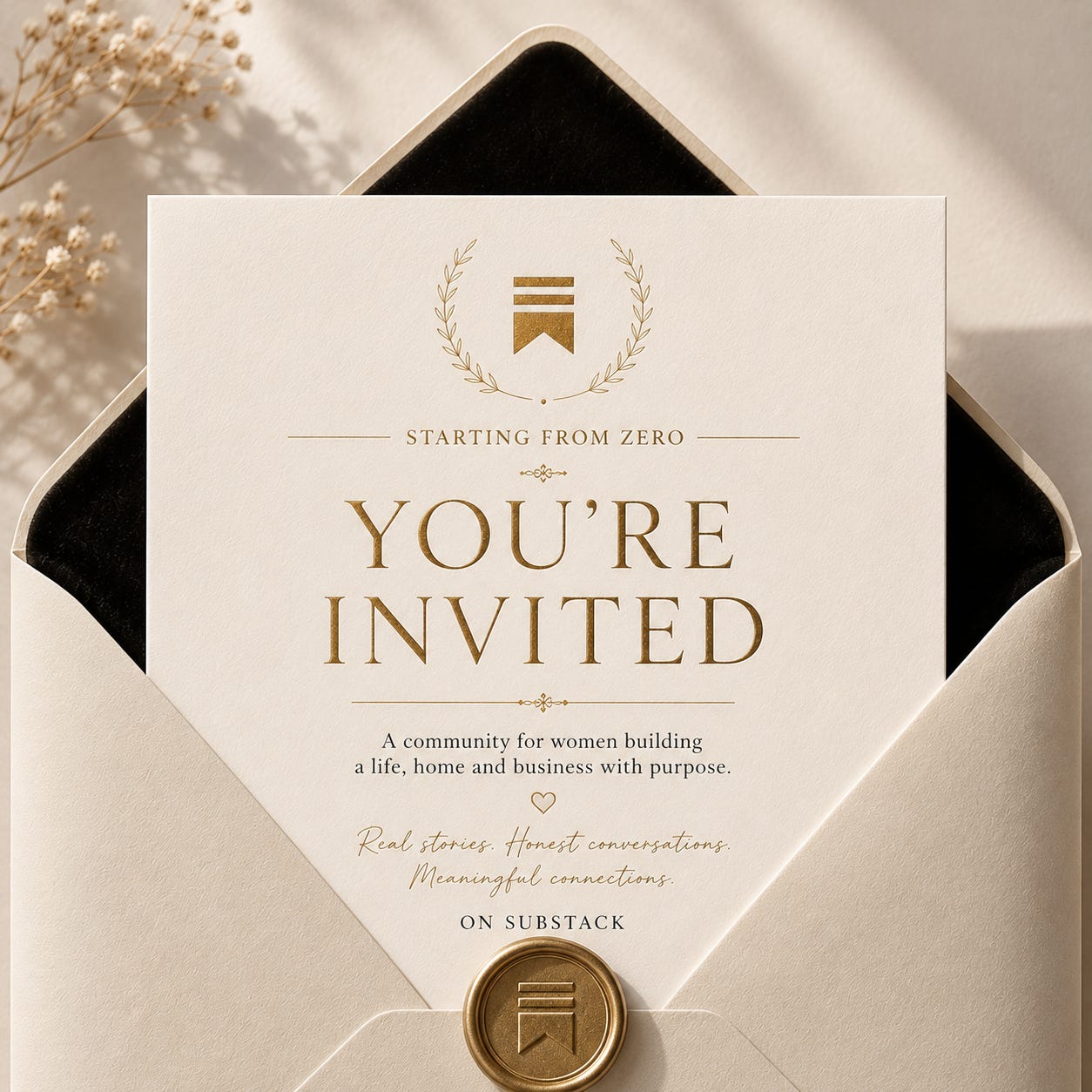

Become A Monthly Paid Subscriber
If you want premium content and closer access to my best work.
✔ The Editor’s Letter - One deep-dive article every month that highlights the live interviews, insights and the honest take-aways of nurturing a sustainable business and lifestyle.
✔ A Daily Intention in Notes - Small prompts that keep you moving.
✔ Intentional Conversations - Live conversations about Starting From Zero and Redefining Success.
✔ The Annual Vision Board Workshop - A guided session to map the year ahead with intention. Takes place every January.

Annual Membership Special
Pay Annually & Unlock Bonus Content:
✔ Quarterly Workshops - 4 x Members-only live workshops from dedicated Wellness Experts & Special Guests.
✔ Private Networking Sessions - Quarterly Substack Social, Annual-members-only Zoom to learn, connect, collaborate and meet other women doing great things.
✔ 10% off working with me 1:1 - When you’re ready for hands-on, strategic support, your subscriber discount applies to a Power Session.
→ See full details on the Become a Member page.


From my heart to yours,
Outside of Substack, you’ll find me creating Intentional Living Magazine and helping private clients build their platforms through House of Brand.